Unveiling Generative AI: The Future of Content Creation
Artificial Intelligence (AI) has been making significant strides in recent years, transforming various aspects of our daily lives and revolutionizing numerous industries. One of the areas that has seen considerable growth and holds immense potential is Generative AI. This subfield of AI and Deep Learning (DL) is focused on generating new content, such as images, text, music, and video, using algorithms and models trained on existing data using Machine Learning (ML) techniques.
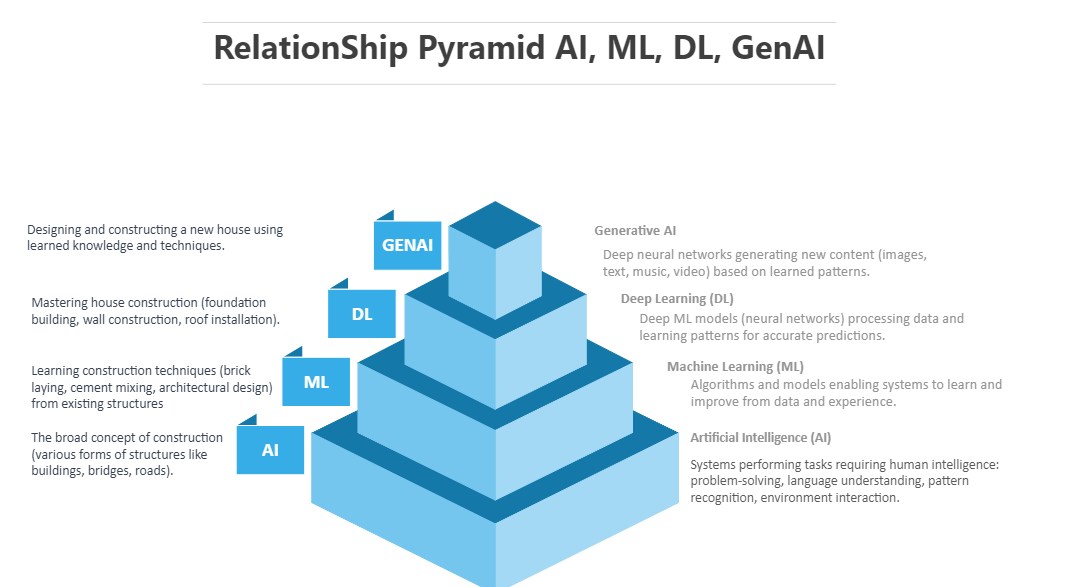
To better understand the relationship between AI, ML, DL, and Generative AI, let's delve into each of these concepts and explore how they are interconnected.
The Foundation: Artificial Intelligence (AI)
AI is the broad field that encompasses creating systems capable of performing tasks that typically require human intelligence and ability. These tasks include problem-solving, understanding natural language, recognizing patterns, and interacting with the environment. AI is the foundation upon which other specialized and focused areas of study and application, such as ML, DL, and Generative AI, are built.
The Next Layer: Machine Learning (ML)
ML is a branch of AI that focuses on creating algorithms and models that enable systems to learn and improve themselves over time and with training. ML models learn from existing data and automatically update their parameters as they process more data and gain experience. This ability to learn from data and improve performance over time is what sets ML apart from traditional programming.
Diving Deeper: Deep Learning (DL)
DL is a sub-branch of ML that encompasses deep ML models, known as neural networks. Neural networks are inspired by the human brain's structure and functioning, consisting of multiple layers of interconnected nodes (neurons) that process data and learn patterns. DL models are particularly suitable for domains such as computer vision or Natural Language Processing (NLP), where they can infer patterns and make predictions based on data. When we talk about ML and DL models, we typically refer to discriminative models, whose aim is to make predictions or infer patterns from data.
The Pinnacle: Generative AI
Generative AI is a further sub-branch of DL that leverages the power of deep neural networks to generate brand new content, from images to natural language, from music to video. Unlike discriminative models, which classify, cluster, or make predictions on existing data, generative models create entirely new content based on patterns learned from existing data.
Analogy: The Art of Painting
To illustrate the relationship between AI, ML, DL, and Generative AI, let's use the analogy of painting.
AI is like the broad concept of art. It encompasses various forms of artistic expression, from painting to sculpture, from music to dance. In this analogy, AI represents the ability to create art, encompassing various techniques and mediums.
ML is like learning the techniques of painting. An artist learns different techniques, such as brush strokes, color mixing, and perspective, by practicing and studying existing works of art. Similarly, ML models learn from existing data and improve their performance over time.
DL is like mastering the art of painting portraits. Portraits require a deep understanding of human anatomy, facial expressions, and skin tones. Similarly, DL models dive deep into the data, learning intricate patterns and relationships that enable them to make accurate predictions.
Generative AI is like creating an entirely new portrait. An artist uses their knowledge of anatomy, facial expressions, and techniques to create a new portrait that has never been seen before. Similarly, generative models use the patterns and relationships learned from existing data to create entirely new content.
Conclusion
Generative AI is an exciting and transformative field that leverages the power of deep neural networks to create entirely new content. From generating realistic images to composing music, from writing coherent text to creating videos, generative models are revolutionizing the way we create and consume content. As this field continues to evolve and find new applications, it holds the promise of unlocking new possibilities and transforming various industries.